You Google "churn prevention software" and three names come back: ChurnZero, Churnkey, Customerscore.io. They all promise to fix your retention. They all have convincing homepages. Which one actually fits your company?
Honest answer: none of them is universally better. They solve different problems for different companies at different stages. I've used all three in consulting engagements and I'll lay out what each is good at, where it breaks down, and who should buy it.
Quick answer
- ChurnZero for mature CS teams at $10M+ ARR with budget for enterprise implementation.
- Churnkey for self-serve PLG SaaS, B2C subscriptions, and media where most churn happens at the cancel button.
- Customerscore.io for early-stage SaaS that wants AI churn prediction on a free tier.
Revenue Plumber sits between these. More on that below.
ChurnZero
What it does well
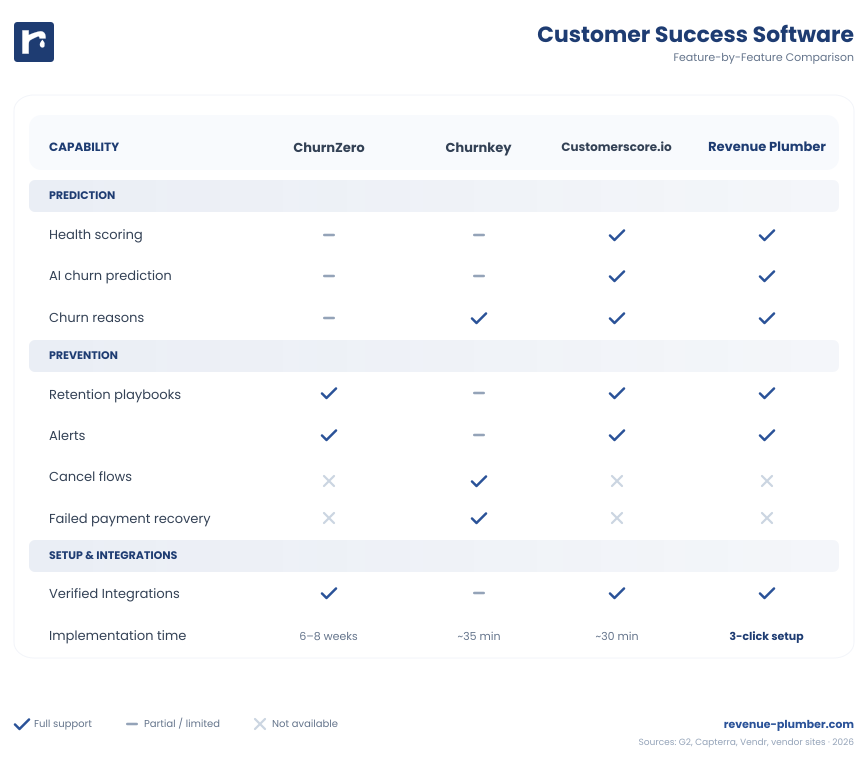
ChurnZero is the most mature of the three. Full Customer Success platform with health scoring (they call them ChurnScores), customer journeys, in-app messaging, playbooks, and renewal forecasting. Success Insights adds ML-based churn prediction on top of the rules-based health scores, so you get both signals. Named a Leader in the 2025 Gartner Magic Quadrant for Customer Success Management.
Recent additions like Engagement AI (drafting customer emails) and Snapshot AI (summarizing account status) keep the product competitive with newer tools.
Where it struggles
Implementation takes 6 to 8 weeks minimum, sometimes stretching to 3 months for complex multi-system environments. Requires dedicated CS Ops resources to configure and maintain. Reporting is the most-cited weakness across G2 and Capterra reviews — teams need multiple dashboards to get the data they want.
Pricing scales quickly. Vendr data shows median contracts running from $15K per year for small deployments to over $90K for mid-market teams with 250+ users, plus implementation fees of $1,500 to $15,000.
Pricing
No public pricing. Expect $12K minimum annual contract, custom quotes above that, plus implementation fees. All deals require annual commitment.
Who it fits
Series B+ SaaS with $10M+ ARR, a dedicated CS Ops function, and at least 10 CSMs managing books of business. If you're a 20-person startup, this will bury your team in configuration work.
Churnkey
What it does well
Best-in-class at one specific moment: customer intent to cancel. Their Cancel Flows reduce voluntary churn by up to 54% on their own benchmarks. Payment Recovery recovers up to 89% of failed payments using ML-optimized retry schedules. The Intelligence Suite adds Account Agent (scans your retention setup weekly for gaps), Adaptive Offers (self-learning discount and pause offers), and Feedback AI (auto-categorizes cancellation reasons into themes).
Time to integrate: about 35 minutes. Native connections to Stripe, Chargebee, Paddle, Braintree, Zuora, Maxio, Recurly. API integrations to HubSpot, Salesforce, Segment, Klaviyo, and Slack. Built for self-serve subscription businesses.
Where it struggles
Not a Customer Success platform. No proactive health scoring across your base, no CSM account workflows. When a B2B customer cancels, usually they decided weeks earlier — Churnkey catches them at the end of the funnel, not during.
Discounting at the cancel moment trains users to threaten cancellation for lower prices. Churnkey's Adaptive Offers limit repeat usage, but the underlying dynamic exists.
Pricing
Starter at $250/month for teams with less than $5K in monthly churn volume. Higher tiers scale with churned revenue. Enterprise custom.
Who it fits
Self-serve PLG SaaS, B2C subscriptions, media and memberships. Anywhere customers cancel themselves with a button click. If your customers cancel by emailing their Account Executive, Churnkey doesn't apply.
Customerscore.io
What it does well
ML-based churn scoring that rates every customer 1-5 with the factors behind each score. They publish 93% accuracy on their benchmark. Setup takes about 30 minutes. Integrations cover the standard SaaS stack: HubSpot, Stripe, Chargebee, Mixpanel, PostHog, Segment, plus databases like PostgreSQL, MySQL, Snowflake.
Their Free tier covers up to 1,000 customers — the most generous entry in this category. That's enough for most startups to run real production workloads before paying anything.
Where it struggles
Newer entrant than ChurnZero or Churnkey. Smaller team, smaller customer base, fewer reviews (17 verified on Capterra) than established players. Playbook library is thinner than the big CS platforms.
Enterprise features like SSO, custom integrations, and dedicated CSM sit behind the Scale tier (custom pricing). If you need those, you're out of the advertised range.
Pricing
Free up to 1,000 customers. Start at $199/month up to 10,000 customers. Scale custom above that. Per-customer pricing, no per-seat fees.
Who it fits
Early and growth-stage B2B SaaS that need churn prediction without committing to enterprise contracts. The Free tier is generous enough to run real production workloads for startups under 1,000 customers.
A framework for picking the right category
Before comparing features, answer three questions about your business:
Where does churn actually happen? If most of your customers cancel through an AE or by not renewing an annual contract, Churnkey doesn't apply — they own the self-serve cancel moment. If customers cancel themselves through a settings page, Churnkey owns that moment.
Do you need prediction or interception? Prediction tools (ChurnZero, Customerscore.io, Revenue Plumber) flag customers weeks before they leave. Interception tools (Churnkey) save them at the moment of cancel. These are different problems. Many B2B SaaS companies need prediction because their customers never hit a self-serve cancel button.
What's your stage and budget? ChurnZero starts at $12K+/year. Churnkey at $250/month. Customerscore.io at $0 (free tier up to 1,000 customers) or $199/month. Revenue Plumber at €74.99/month. Company stage should drive the tier, not the other way around.
Where Revenue Plumber fits
Revenue Plumber was built for B2B SaaS teams on HubSpot + Stripe that want prediction and prevention in the same tool, without enterprise setup cost.
Versus ChurnZero: same prediction capability, minus the 6-8 week implementation and five-figure contract. Stripe connects in one click, HubSpot in three. Churn risk scores available the same day. Built for teams under 10 CSMs.
Versus Churnkey: we catch churn weeks earlier, not at the cancel button. For B2B SaaS with AE-led sales motions, cancel flows don't apply — customers don't self-cancel. Our alerts fire when usage patterns shift, so your team can intervene while the relationship still has value.
Versus Customerscore.io: honest comparison here. Their Free tier is compelling if you're under 1,000 customers — consider it. Where we differentiate: HubSpot integration runs deeper (churn scores and reasons sync directly into HubSpot contact properties so your CSMs see them where they already work), retention campaign templates are built in rather than something you build in Zapier, and alerts are configurable for B2B-specific signals like contract expiry proximity. Above 1,000 customers we come in cheaper: €75/month vs $199.
Starting at €74.99/month. Stripe connects in 3 clicks. 14-day free trial, no card required.
Bottom line
These four tools solve different problems:
- ChurnZero for enterprise CS teams with budget and ops headcount.
- Churnkey for self-serve PLG and subscription businesses fighting cancel-button churn.
- Customerscore.io for early-stage SaaS wanting AI prediction on a free tier.
- Revenue Plumber for growing B2B SaaS on HubSpot + Stripe that need prediction plus prevention without enterprise setup.
The question isn't which is best. It's which solves the problem you actually have.
See how it works on your data
Book a 30-minute demo or start your free trial. No credit card required.